How we
got here.
A story about a pool party, a missing phone, two favorite numbers, a pair of paintings, and the various things that begin to look less accidental after enough years together.
We met in the summer of 2019, at a pool party Scott had been invited to by his cousin's best gay friend from high school, whom Scott had himself met at his cousin's wedding. This is a cumbersome sentence, but an accurate one, and perhaps a useful reminder that the events which later appear inevitable usually begin in arrangements no sensible person could have designed.
Scott had just moved from Buffalo to Boston to begin a postdoc. Michael was already there. They met at the party, shared an Uber back to Michael's place later that night, and somewhere in the course of things Scott managed to leave his phone in the car.
There are more dignified ways of ensuring that a person one has just met remains in one's life, but perhaps fewer effective ones. The phone had to be found; messages had to be exchanged; contact became temporarily compulsory. Before either of us had much opportunity to become strategic about the matter, we were already talking.
A few days later Michael took Scott to a speakeasy. Scott had never been to one and was enormously impressed - not only by the place, but by the fact that Michael seemed to know that places like it existed. This would become a recurring feature of the relationship. Michael opened doors, sometimes figuratively and sometimes simply because he knew where the door was. By August, we were boyfriends.
Love is often described as though another person supplies something that was missing. That has never seemed quite right to us. People arrive with plenty already inside them: habits, stories, private systems of meaning, irrational attachments to particular foods and songs and numbers. Intimacy does not necessarily erase these eccentricities. More often, it gives them someone else to live with.
Scott, for example, came with 918. When he turned nine, his bedtime was extended until nine o'clock. The final time he remembers seeing with any regularity before sleep arrived was 9:18. After that he began seeing it everywhere - or, more plausibly, began becoming unusually good at noticing when it appeared. The distinction has never seemed especially important.
Michael had a number too: 634, remembered from his grandmother's telephone number in Scotland. Its origin was entirely different. One number came from a childhood clock, the other from a childhood telephone; both somehow survived into adulthood after their original usefulness had disappeared.
We knew each other's numbers for years before anyone thought to do arithmetic with them. Scott eventually did.
A few entirely normal facts about us
| Scott | Michael |
|---|---|
| Favorite number: | Favorite number: |
| Navigation: aspirational | Navigation: useful |
| Notices patterns | Lives with someone who notices patterns |
There is a minor danger in discovering a coincidence: afterward, the world becomes rather crowded with possible ones. Scott had always known what date he wanted to be married on, provided the calendar ever cooperated. Once he knew that he wanted to marry Michael, he looked up September 18, 2027.
It was a Saturday. That settled it.
The attraction is embarrassingly simple. Each number advances by nine: the month is nine; the day is nine plus nine; the year ends in nine plus nine plus nine. It is not an argument for anything. It is simply a pattern Scott had been carrying since childhood, now large enough to put a wedding inside.
Long before any of this, the Spanish painter Luis Feito had already given the number to a painting. Painting 918 was made in 1972. Its title caught Scott first, inevitably; the picture held him for another reason.
Near its center are two rounded forms. Scott sees the backs of two heads: two people facing away from us, one inclined toward the other. It is not necessary that anyone else see them this way. One of the privileges of looking at art is that eventually a picture begins to contain some of the person looking.
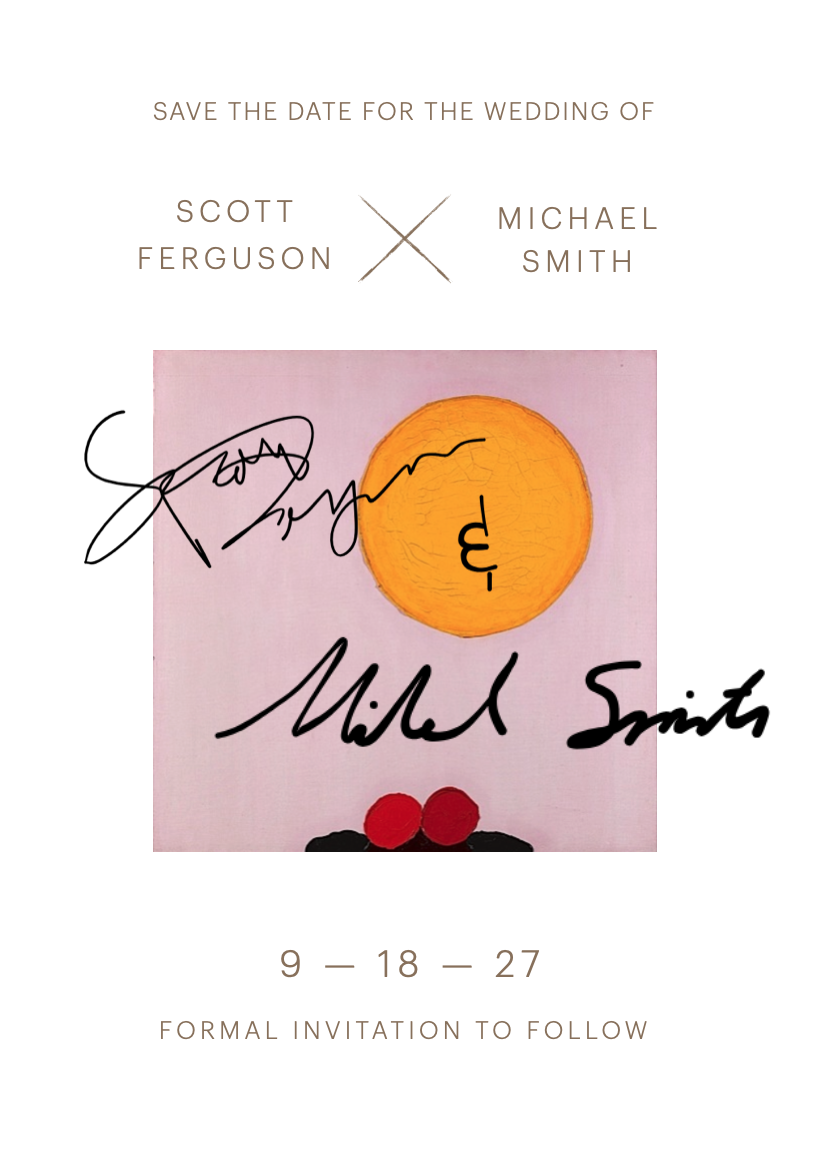
Painting 918
Michael, meanwhile, had arrived with a painting of his own. His favorite was Caspar David Friedrich's Wanderer above the Sea of Fog, painted around 1818. He loved it before he knew Scott, and before he knew that Scott had long thought of himself, with varying degrees of seriousness, as a wanderer.
The resemblance is imperfect. Friedrich's wanderer surveys the sublime from a mountaintop; Scott has historically had difficulty navigating a parking lot. Michael is the better navigator, the better keeper of practical reality, and the person who has more than once supplied structure to one of Scott's spontaneous ideas. He also quite literally got Scott glasses. The metaphor therefore has the unusual advantage of having been tested experimentally.
Michael does not make Scott wander less. He makes it easier to see where they are.
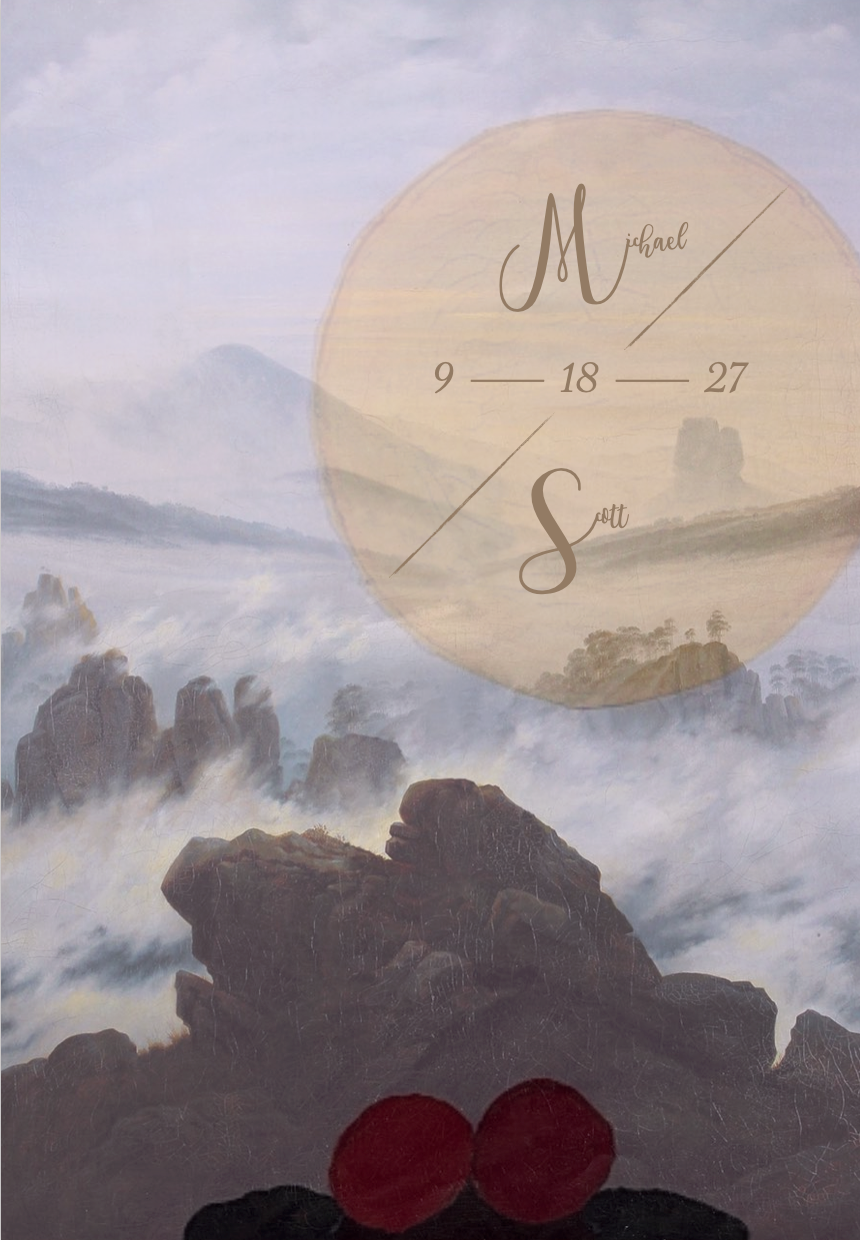
At some point Scott found a version of Friedrich's landscape without its solitary figure and placed Painting 918 over it. There is no coincidence to claim here; this part was deliberate. But deliberate symbols can still reveal something.
The lone wanderer disappears. The two forms remain above the fog. What Scott sees in the composite is not rescue, or destination, or even certainty. The landscape is still enormous and partly hidden. There is simply another person at the overlook.
The world has not become less strange. It has become strange together.